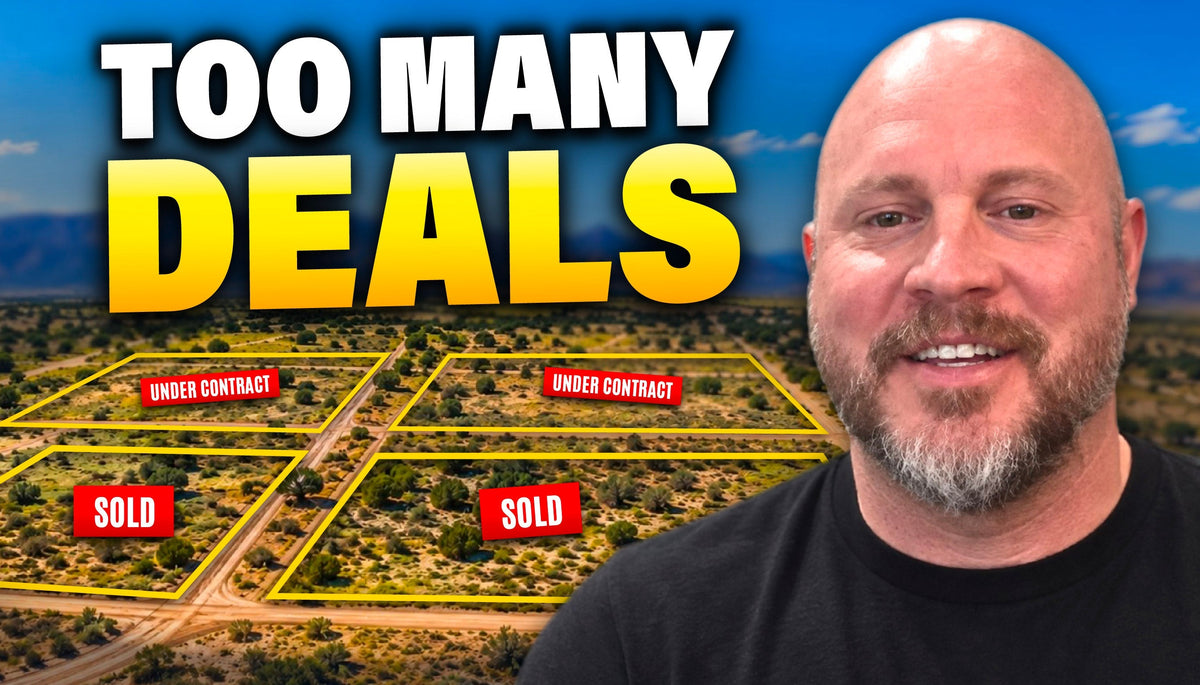
How “Double Closing” Can Be Your Secret Weapon in Land Investing

If you invest in land, or off market properties, at some point you may run into a situation where a motivated seller wants more than your cash offer, but you know there is a buyer out there willing to pay what the seller expects.
That is where the strategy commonly known as “double closing” becomes a game changer. In fact, the mechanics are simple, what really matters is how you talk about it.
What Is a Double Close, And Why Investors Use It
A “double closing” also called a “back to back closing,” “double escrow,” or “simultaneous closing,” is a common technique in wholesale real estate.
It involves two separate but consecutive transactions:
First, you, the investor, contract with the original seller, the property goes under contract, and you plan to buy it.
Then, you contract with an end buyer who will purchase the same property at a higher price.
On closing day, ideally same day or within a short window, the first deal closes, seller to investor, and then the investor immediately closes the second deal, investor to end buyer.
Because the deals are handled as separate transactions, neither the seller nor the end buyer sees your profit margin, the “spread.” They only know their side of the deal, which preserves confidentiality and removes friction around perceived “markup.”
Why Most Investors Miss the Opportunity
Many investors assume the most difficult part of a double close is the paperwork or logistics. But actually, the hardest part is how you present it to the seller.
Most investors make mistakes such as:
- Over explaining the double close
- Sounding hesitant or salesy
- Making the seller feel like something unusual or risky is happening
- Walking away from deals that were workable

The seller does not care about your strategy, they care about their outcome, their timeline, their certainty, and the final number they walk away with.
Double closing is simply a tool to deliver those outcomes.
When to Introduce the Double Close Option
Double closing makes sense only in certain situations. Here are the clearest signals:
1. The Seller Wants a Higher Price, But It Is Still Achievable
If your cash offer is $50,000 and the seller wants $70,000, that gap might be reachable using a double close.
2. The Seller Is Focused on a Specific Number
For example,
“I need $70,000 to pay off debt,”
“I cannot go lower,”
“I must walk away with this amount.”
These phrases indicate strong motivation and a target number that you may be able to meet using extra time.
3. The Seller Is Flexible on Timeline
If the seller says, “I am not in a rush,” or “I do not need to close quickly,” then the door is open for a longer contract period in exchange for the higher price they want.
How to Talk to the Seller - Scripts That Work
The key is to keep the conversation simple and emphasize the seller’s benefits, not your strategy.
Option A, Option B Method
“I can give you two options:
• Close fast at $50,000,
• Or give me about 60 to 90 days and I can reach your $70,000.
Whatever works best for your timeline is fine with me.”
Giving choices allows the seller to feel in control.
Timeline Trade Off Script
“If you are flexible on timing, I can get closer to your number. If we use a 60 to 90 day contract, I can make the $70,000 work. If you want to close quickly, the offer stays at $50,000.”
This frames everything around timing, something sellers understand intuitively.
Motivation Driven Script
“I want to help you reach that $70,000. To do that, I just need a little extra time in the contract, around 90 days. If that works for you, I can get you there.”
This is effective for emotional or urgent situations.

How to Negotiate, Without Sounding Like You Are Negotiating
Let the timeline be the variable, not the price. A calm, confident sentence works best,“I am firm on fast close pricing, but if you want a higher price, I can make that happen with a little extra time. It is totally up to you.”
This creates a natural, logical tradeoff.
More time, more money.
Less time, less money.
This concept is normal in real estate, and when stated plainly, sellers accept it easily.

How to Handle Seller Objections
“Why do you need more time?”
“It gives me time to complete everything needed for the higher price, nothing complicated.”
“Is this risky for me?”
“No, your price is guaranteed. We use a standard contract, and everything is handled through a title company.”
“I want to close fast but still get $70,000.”
“If closing quickly is most important, the $50,000 offer works. If the $70,000 is most important, we just need a little more time. You choose.”
**Important
Do not use the term “double close” unless they ask. Instead, say:“It is a standard back to back closing. Title handles everything.”
Want to See These Conversations in Action?
For a real world example of how a land investor confidently uses double closings and handles seller conversations, watch this interview with Kay Walker.

Behind the Scenes, What Actually Happens in a Double Close
Even though you do not need to explain the mechanics to a seller, you still need to understand what is happening.
- You are the legal buyer in the first transaction.
- You are the legal seller in the second transaction.
- You may use the end buyer’s funds, or transactional funding, to complete the first close.
- Closing costs occur twice, so the profit margin must support the strategy.
- Some states and title companies have specific rules, so you must know your local process.
Final Thoughts
Double closing is not a loophole, not a trick, and not a complicated tactic. It is a practical tool that helps sellers get the price they want while giving you room to profit.
The investors who excel with this strategy are not the ones who know the legal mechanics in extreme detail, they are the ones who know how and when to have the conversation.

Chat with a
land investing
advisor
Discuss any questions you have about land investing, our online community or courses!